

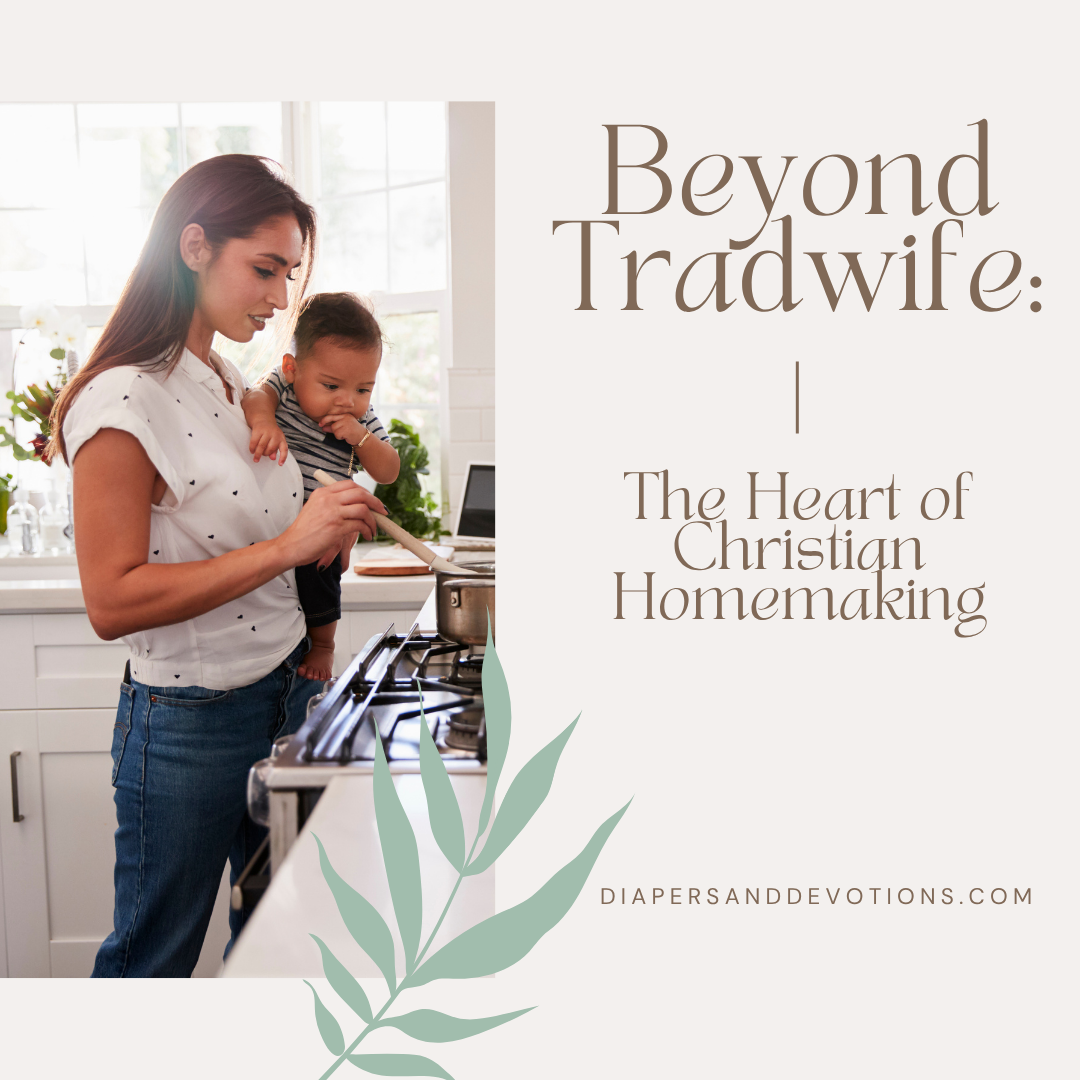
There’s a new kind of “perfect” floating around the internet.
If you’ve spent any time on Instagram or TikTok lately, you’ve likely seen it: perfectly curated kitchens, women in aprons with red lipstick, sourdough bubbling in the background, and a voiceover saying, “I love submitting to my husband. I love being a traditional wife.”
This is part of the growing tradwife movement—short for “traditional wife.” It’s a viral trend where women embrace old-fashioned homemaking roles, often modeled after 1950s America. There’s baking from scratch, raising babies, and making everything beautiful and peaceful at home. And while that may sound charming and even familiar, there’s something deeper that needs untangling.
Because while some aspects of the trend are lovely, Christian homemaking is not just a vintage aesthetic. It’s a spiritual calling.
What Is the Tradwife Trend?
The tradwife trend promotes a lifestyle centered around traditional gender roles, feminine expression, and homemaking. These women often speak about anti-feminism, staying home, and submitting to their husbands with delight. They showcase modest fashion, handwritten notes, and slow living.
On the surface, there’s beauty to it. There’s something about slowing down, cooking meals from scratch, and embracing femininity that feels counter-cultural in a good way.
But here’s the issue: when we begin to idolize an image, we think we have to look or act a certain way to be “holy.” In doing so, we’ve stepped out of freedom and into performance.
What the Bible Actually Says About Homemaking
Christian homemaking isn’t a costume. It’s not a mood board. It’s not about whether your aesthetic is “cottagecore” or “coastal grandmother.”
Biblical homemaking is a heart posture. It’s rooted in God’s Word—not nostalgia.
In Proverbs 31, we see a woman who works with her hands. She buys and sells land. She speaks with wisdom and fears the Lord. She serves her family faithfully. She’s strong, industrious, generous, and spiritually grounded.
Titus 2:3–5 advises older women to teach the younger to be self-controlled and pure. They should also work at home, be kind, and be submissive to their own husbands. This isn’t about performing a role. It’s about living out God’s design in a way that honors Him.
In short: Christian homemaking is not passive or performative. It is active, wise, and holy.
When Aesthetic Becomes an Idol
We need to be careful not to confuse beautiful homes with obedient hearts.
A woman can be covered in flour, surrounded by children, and still be far from the Lord. Another can be in yoga pants, sipping reheated coffee on a sticky floor, and be walking closely with Him.
God looks at the heart (1 Samuel 16:7). We risk missing the sacred when we turn our homes into stages. Our motherhood becomes content as well. This happens in favor of the seen.
There’s nothing wrong with taking joy in homemaking. But when the joy turns into comparison, judgment, or pressure—it’s time to step back and ask who we’re really serving.
What Christian Homemaking Looks Like in Real Life
In our home, Christian homemaking isn’t always photo-ready. But it is full of purpose.
We make our own cleaners with simple ingredients and Revive essential oils. We do this not because it’s trendy. We want to steward what God has given us well. We diffuse calming oils in the morning as part of our rhythm.
The laundry gets line-dried when possible. It’s not just to save money. I love the way the sun and wind feel like God’s provision in motion. I usually toss a load in before bed and hang it up during my quiet time in the morning.
We’ve got a pothos named Drucilla who lives in nearly every room. She’s been passed down in my husband’s family for generations and propagated more times than I can count. She’s a reminder that simple, faithful tending leads to growth.
Dinner gets made with the little ones underfoot. The house is filled with laughter, correction, prayer, and sometimes tears. And in all of it, I pray that our home reflects not perfection, but peace.
This is Christian homemaking. It’s showing up with a willing heart, even when the to-do list feels bigger than the time. It’s asking God to be glorified not just in Bible study, but in sweeping floors and kissing scraped knees.
Grace Over Image
You don’t need a bread starter or a capsule wardrobe to be a godly wife.
You need grace.
Grace for the mornings when the baby wakes early and nothing gets done. Grace for the days when your temper runs thin and dinner is cereal. Grace when you look at another mom online and wonder if you’re enough.
Galatians 1:10 reminds us, “Am I now trying to win the approval of human beings, or of God?”
Approval from the internet will fade. But faithfulness in your home? That echoes into eternity.
Final Thoughts: Don’t Trade Truth for Trendiness
The tradwife trend may stir something in you. Maybe it’s a desire for peace, beauty, or slower rhythms. Those longings aren’t bad. But they’re not the whole picture either.
Christian homemaking isn’t about mimicking the past. It’s about ministering in the present.
So friend, whether you’re folding laundry or reading bedtime stories, know this. Whether your home smells like sourdough or baby wipes—know this. If you’re doing it with love and unto the Lord, it matters.
God is not asking you to perform a lifestyle. He’s asking you to be faithful in the one He gave you.
💬 Want to connect?
Have you felt the tension between trend and truth in homemaking? Share your heart in the comments or message me privately. I’d love to encourage you.
